It may surprise you to learn that there was once a Prisoner of War Camp in Monymusk, which was sited on the present St Ninian's Housing Estate and the Football Field. At the start of the Second World War in 1939 there were just 2 prisoner of war camps in Britain but by the end of the war there were around 487. Monymusk Camp was given the official number 111, also called 'Deer Park, Monymusk'. It had the capacity to hold around 1300 men and officers in approx. 23 accommodation huts and 68 tents on the 25 acre site. For an aerial photograph of the village and POW camp in 1948 click here.
The huts at Monymusk had a concrete base and frame, and were built from hollow bricks with a pitched corrugated asbestos roof. The huts were used as sleeping and living quarters for the officers as well as the prisoners. They were heated by a pot-bellied stove and those at Monymusk housed 35 men sleeping on simple wooden bunks. There were also blocks for the latrines, wash-houses, cook house, boiler house, canteen, stores and medical areas.
Sporting activities, workshops, concerts and lectures were put on inside the camp. Mr Whiteley who was the Dominee of Monymusk School gave Monday evening English lessons to the prisoners. Many of the PoWs worked at the farms in the area and had picked up some of the local Scots words, for example when Mr Whiteley was teaching them the English word for 'potato', he was corrected by the PoWs with "na, na, tatties"!
There is an interesting article on the Kemnay Village website about a local man's experience of wartime in the area: World War II Memories of Alastair Craig in which he also mentions the Italian POWs from the Monymusk camp!
Some of the Catholic refugees built a small chapel in one of the huts. They constructed the altar from wood, cardboard and tin and a Urkranian artist decorated it with paintings of famous Saints and a copy of Leonardo Da Vinci's Last Supper over the altar. There was also an elaborate chandelier made from biscuit tins. Mrs Whiteley attended the inauguration ceremony for the chapel and later said she was "moved to see those weather beaten faces with tears on their cheeks." After the ceremony there was a dinner celebration of bortsch which is an eastern European dish made from beetroot.
Altar constructed by Catholic PoWs
Sadly all that remains of this altar at Monymusk is this photo. There were many chapels and works of art produced by PoWs in the British camps but there are few surviving examples of their work. The Ukrainian POW Chapel built in the Scottish Borders near Lockerbie does still exist and was very similar to the one at Monymusk
Many prisoners worked on the local farms, harvesting, digging ditches and repairing fences and prisoners with particular skills such as joiners or tradesmen were very useful. A former resident of Monymusk told me he could remember the bus coming to pick up the prisoners each day to take them to neighbouring farms on the Estate. Relations were good between some of the prisoners and the local residents. The Estate Forester, Alexander Horne of Tombeg Cottages was apparently given a carved wooden horse as a present from one of the prisoners.
The camp at Monymusk held mainly Italian PoWs. German PoWs were usually shipped over to Canada or the USA, as the authorities were very worried about the threat of an organized revolt from within the camps due to the high numbers of prisoners in Britain. After 1945, many of the German PoWs were transported back from Canada and the USA to the British Camps. In 1946 there were over 400,000 German PoWs in Britain. The situation in Germany and in parts of Eastern Europe was very volatile with a mass exodus of people, hunger and destruction following the defeat, and many prisoners did not want to return to their homeland immediately so the camps became places for refugees and other displaced people from Europe. These hostels were known as EVW (European Voluntary Worker) Hostels and the Monymusk camp also became a hostel for Polish and Eastern European refugees at the end of the war.
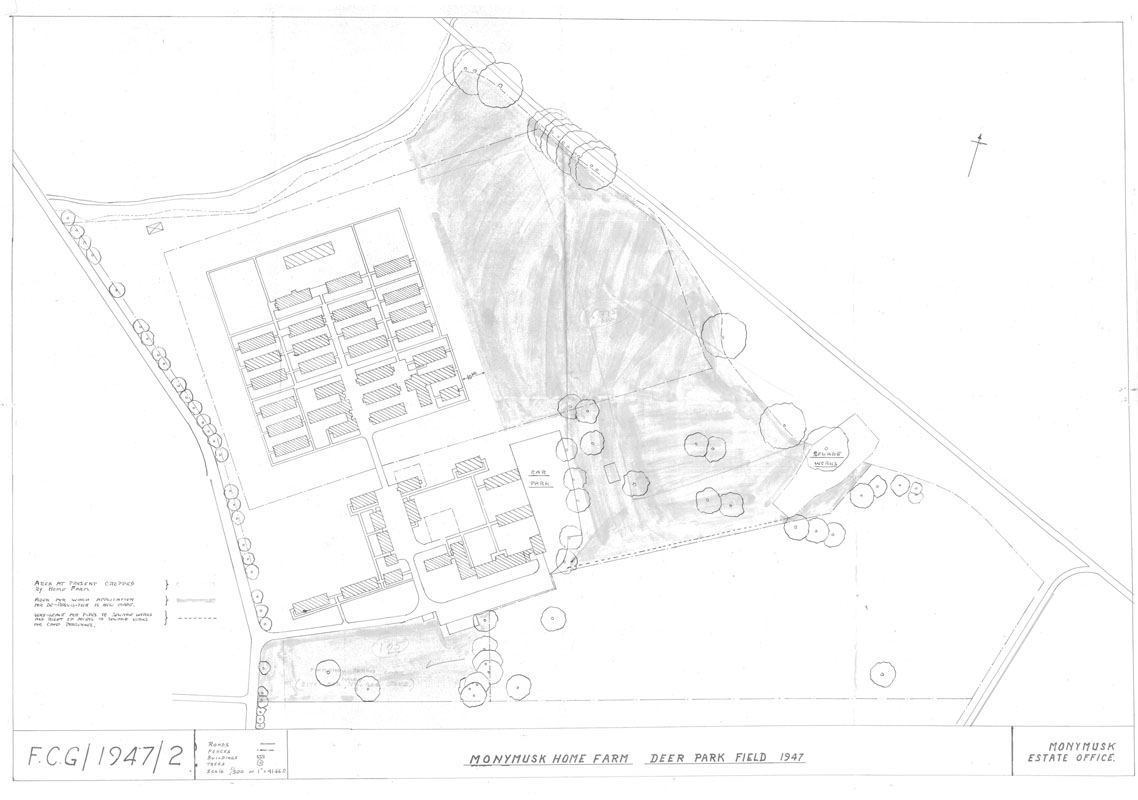
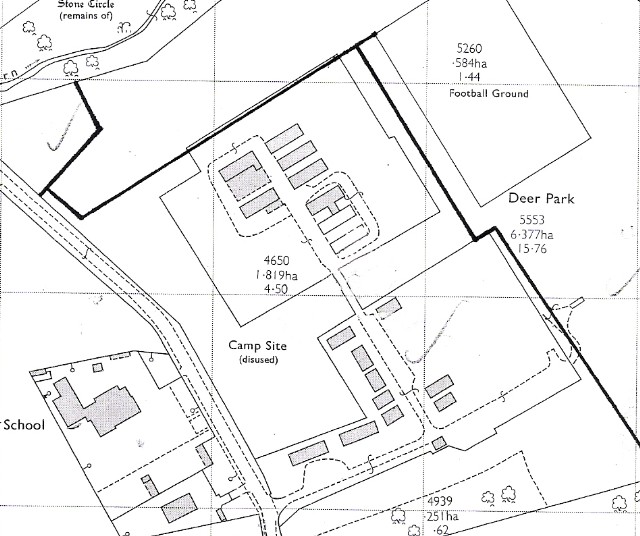
The POW camp maps in 1947 and 1977 show the camp becoming much smaller as the land was gradually de-requisitioned (i.e. released from government control) and the huts sold off to local people or local firms as they were no longer needed. The camp was demolished completely in the early 1980s when the land was sold off to private developers to build St Ninian's Housing Estate, which can be seen in the bottom right of the aerial shot below.
Aerial view of former POW camp
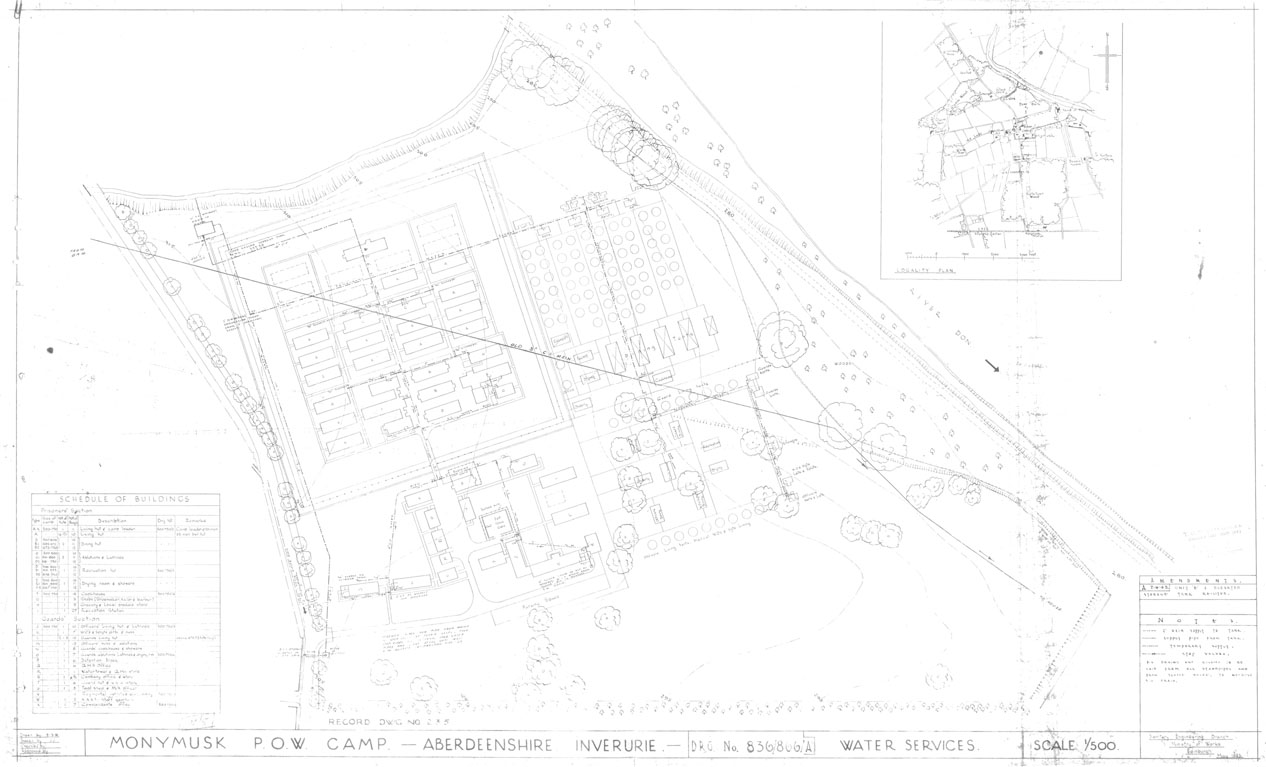
Monymusk POW Camp, Water Services, Ministry of Works, Sanitary Eng. Branch, Edinburgh, 1943.
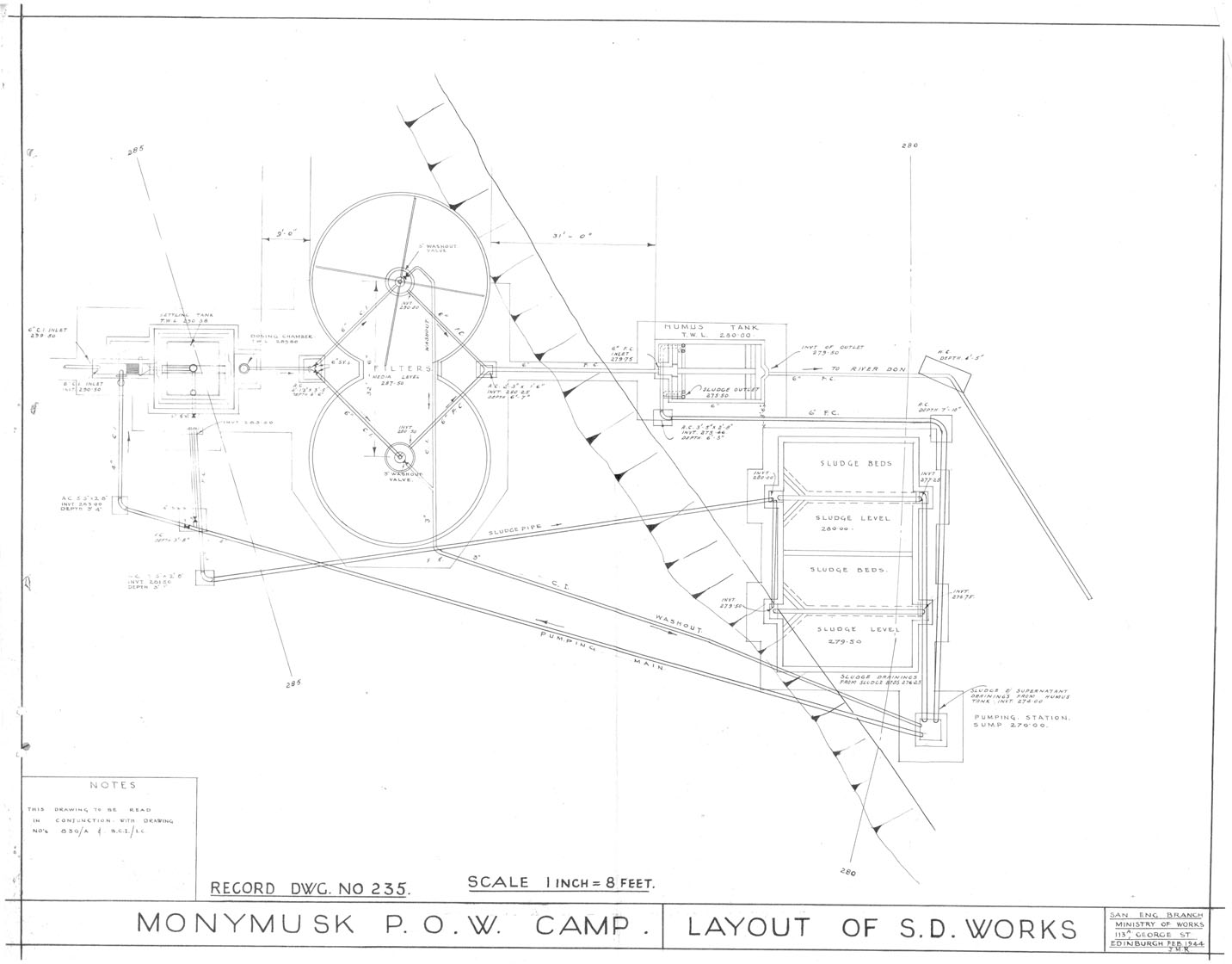
POW Camp, S.D. (Sewage) Works, Ministry of Works, Sanitary Eng. Branch, Edinburgh, 1944.
Monymusk Home Farm, Deer Park Field , 1947 (former POW camp)
Ordnance Survey Map of Monymusk Camp, 1977
Construction of Enzean Bridge, 1940s
Sir Francis Grant was an electrical engineer during the the Second World War. He purchased the bridge and brought it back from Germany after the War. His older brother Sir Arthur Grant was killed in Normandy in 1944 and is buried in one of the huge war cemeteries there. The Enzean Bridge runs over the River Don connecting Enzean Farm and Monymusk Home Farm and was constructed by the German and Italian PoWs from the Monymusk Camp. However the two nationalities refused to work together and every second day would change sides(!), as it was over a mile to walk to the North side of the river and only a quarter of a mile to the South side.
Enzean Bridge - present day
During the bridge's construction, one of the German prisoners fell into the water and had to be rescued by Sir Francis, but the prisoner failed to show any gratitude towards the man who had saved his life.
A jam jar was sunk into one of the concrete uprights with the signatures of German and Italian senior officers and Sir Francis, along with coins of the realm.
During the war Monymusk House was requisitioned by the government to be used as a hospital and the family had to move to another house on the Estate. Furniture from the House was stored in the Episcopal Church - the present Arts Centre Building, the Home Farm and various other buildings on the Estate.
The building was obviously not designed to be a hospital. As the staircases were small and winding and the corridors very narrow it was a challenge to move patients around and into the building. Patients who came in on stretchers had to be hoisted up the outside walls on pulleys and then pulled in through the windows.